RAG that cites its sources: building assistants you can trust
Every internal AI assistant has the same failure story. Week one, the team is delighted. Week three, someone catches it inventing a policy that doesn't exist. Week four, nobody asks it anything that matters. The model didn't get worse, trust just ran out. And trust, it turns out, is an engineering deliverable.
Retrieval is most of the answer
A RAG assistant is only as good as what it retrieves. Before touching prompts, we do the unglamorous work: chunking documents along their actual structure instead of every 500 tokens, combining semantic search with plain keyword matching, because employees search for error codes and invoice numbers, not concepts, and re-ranking so the model sees five relevant passages instead of twenty vaguely related ones. Most "hallucination problems" we're asked to fix are retrieval problems wearing a costume.
Grounding: make it show its work
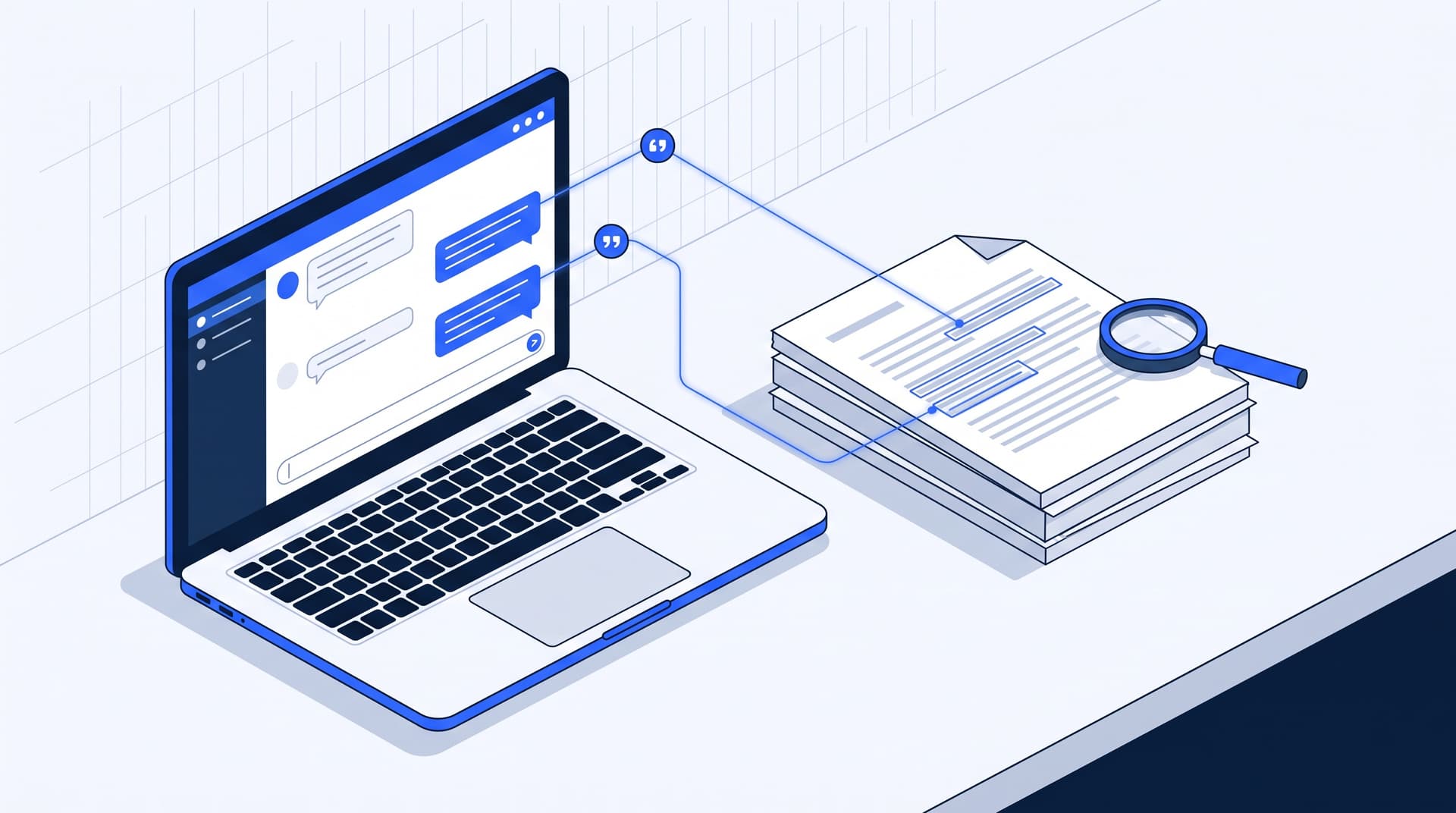
Our assistants answer with citations, every claim linked to the document and section it came from. This does three jobs at once:
- Users can verify, a cited answer takes seconds to check; an uncited one takes a leap of faith.
- The model behaves better, instructing it to answer only from retrieved passages, and to say "I don't know" when they don't cover the question, measurably cuts fabrication.
- Failures become debuggable, a wrong answer with citations tells you whether retrieval, the source document, or the model was at fault.
The "I don't know" path matters more than teams expect. An assistant that admits the docs are silent is trusted; one that improvises an answer is abandoned, usually all at once, by the whole team, after one bad incident.
Evaluation is what keeps it alive
Before launch we build an evaluation set from real questions, the phrasing employees actually use, edge cases included, and score retrieval and answers against known-good responses. That set becomes a regression suite: every prompt change, model upgrade or document reshuffle runs against it before production does. In production, logging which sources back each answer plus a simple thumbs-up signal tells us where the knowledge base is thin, which is where the next week of improvement always comes from.
None of this is exotic. It's retrieval tuning, honest grounding and boring evaluation, done thoroughly. That's the difference between a copilot your team relies on and one they quietly stop opening.
Want a RAG assistant like this in your own product? That is exactly what our AI integration service delivers, evaluation and cost control included.