How to build an MVP: a step-by-step process
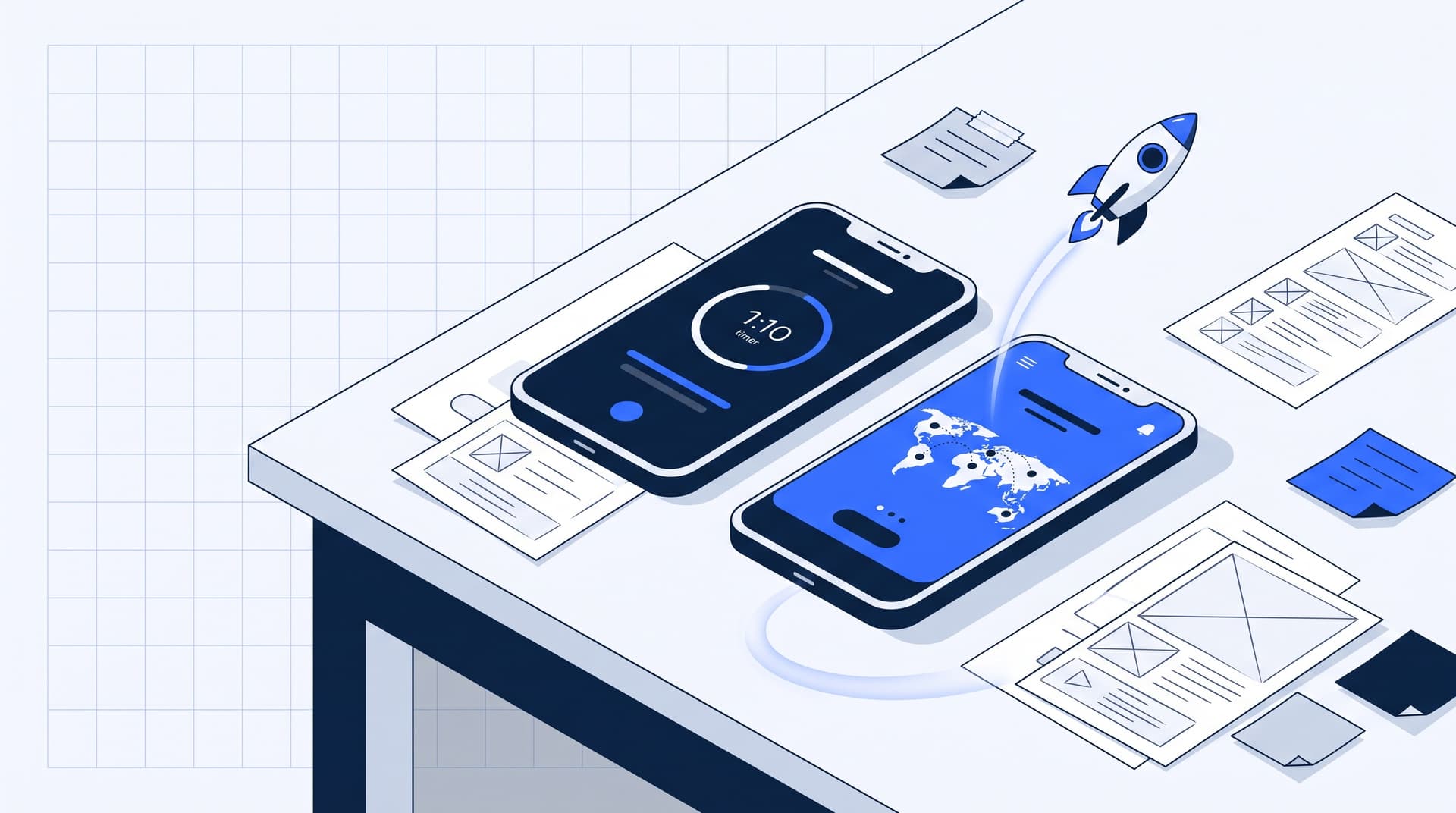
I get asked how to build an MVP more than any other question, so I decided to write the answer down once, properly. Most advice stops at the definition and leaves you at the hardest part: deciding what to build, what to cut, and how to get it live fast without wrecking it for later. This is the exact process we use at Qorinx to take an idea to a launched, paying product, the same one behind our own apps QoFast and SimFuse, both live on the App Store and Google Play.
First, what an MVP actually is
A minimum viable product is the smallest version of your idea that a real customer can use and pay for. Two words carry the weight. Minimum means it does one job, not ten. Viable means it genuinely works in production (real accounts, real payments, real data), not a clickable mockup. An MVP that is minimum but not viable is a prototype; one that is viable but not minimum is just a late, expensive product. You need both.
The steps to build an MVP
The order below is not dogma (some of these run in parallel), but it is the sequence that consistently gets a product live in weeks instead of months, whether it is a web product or you are working out how to build an MVP app for the stores. If budget or schedule is your open question, we have covered how much it costs to build an MVP and how long it takes to build an app separately.
1. Sharpen the idea, then study everyone already solving it
Start by writing down what you are building and the one painful problem it removes, for one specific person. If that takes a paragraph, the scope is still too wide. Then do the market research most founders skip: list every competitor and near-competitor, and map their functionality, their pricing, their reviews and their history: when they launched, what they added over time, what users complain about. Their years of iteration are the cheapest intelligence you will ever get. They tell you which features are table stakes, which are noise, and where the gap for your MVP actually is.
2. Decide how it makes money before you build
Monetization is a design input, not something to bolt on after launch. Decide up front whether you are selling one-off payments, consumable purchases or a subscription, because that choice shapes onboarding, the paywall and even which features make the launch cut. The competitor pricing map from step 1 usually answers it: it shows what the market already accepts. Our own apps went opposite ways on purpose: SimFuse sells one-off eSIM data plans you top up when you travel, while QoFast runs on a subscription because the value recurs with every fast. Both models were fixed before a line of code was written.
3. Design it so everyone sees the same product
Next, make it visual. A short design pass over the core screens and the one journey from signup to value to payment gets everyone (founder, designer, engineers) aligned on exactly where the product is heading before the expensive part starts. Use a sensible design system rather than bespoke pixels, polish the path users will actually take, and ignore the screens they will not see for months. A week of design here saves a month of rebuilding later.
4. Pick the tools that get you live fastest
Then lock the stack, and the selection rule is simple: choose tools that get a real product live fastest without hurting you long term. Ours is boring on purpose: Flutter for one codebase on both stores, Firebase for auth and backend, Stripe for web payments, RevenueCat for in-app subscriptions and purchases. Scaling is kept in mind, but it is not the priority. Launching and testing traction is. Spend your innovation budget on the one thing that makes your product different, not on infrastructure a managed service already does better.
5. Build the production essentials in
Auth, payments, deployment and basic monitoring are not "later". They are what make it viable rather than a demo. Skip them and you have not tested anything a real customer would trust. This is also where the tool choices from step 4 pay off: wiring up a proven auth and billing stack takes days; building your own takes the weeks you were supposed to spend on the product.
6. Prepare the store listing before launch
For an app MVP, basic ASO (app store optimization) is part of the build, not an afterthought: a keyword-researched title and subtitle, a clear description, and screenshots that sell the core loop in the first two frames. It does not need to be perfect at launch. It needs to exist, so the store page starts collecting impression and conversion data you can optimize against from day one.
7. Submit to the App Store and Google Play
If your MVP is an app, the stores are a step of their own, so plan for it. You need an Apple Developer account and a Google Play Console account (Apple in particular can take days to approve a new company account, so open both early). Each build then goes through human and automated review: Apple typically responds within 24 to 48 hours, Google Play is often faster but new developer accounts face extra testing requirements. Reviewers check that the app works, that purchases use the platform billing, and that privacy declarations match what the app does. Subscriptions and paywalls get the closest look, which is another reason to have monetization decided early. Expect at least one rejection round as normal, not as failure, and use TestFlight and Play internal testing to catch issues before review does. Budget a one to two week buffer between "code complete" and "live in the stores".
8. Launch, watch the first payments, iterate on evidence
Get it in front of real users and charge from the start, even if the first cohort is tiny. The strongest validation signal there is, is a stranger paying. Then watch behavior, not opinions: store impressions, install conversion, activation, and above all the first payments. Iterate the listing, the paywall and the roadmap from what real usage shows. Build the next feature because users proved it matters, not because it was on the original wishlist.
What this looks like in practice
This is not a theoretical framework. It is how we ship our own products. Here is how the QoFast case study describes the problem we found in step 1, when the competitor analysis showed every fasting app was a bare countdown timer:
Most fasting apps are just a countdown timer, but people running longer intermittent windows and multi-day extended fasts want to know what is actually happening in their body at each hour, and that physiology is opaque and scattered across blog posts.
That single research insight became the whole MVP bet (show the metabolic phase behind the timer, not just the countdown), and the category told us subscription pricing was the model, because the value recurs with every fast.
And this is how the SimFuse case study describes the approach that came out of mapping eSIM sellers' pricing and reviews, where the gap was not coverage but the path from landing in a country to being online:
We built SimFuse as a purchase-and-provisioning product, not a telecom one. The core is a clean catalog of destination plans, a checkout that issues an eSIM profile, and a guided install that hands the profile to the device eSIM manager in a few taps.
So the MVP obsessed over a roughly 60-second setup and one-off plan purchases you top up mid-trip. Same steps, two very different products (one subscription, one pay-per-purchase), both live on the App Store and Google Play.
How to build an MVP without a technical co-founder
You do not need a technical co-founder to run this process. You need the steps above plus someone senior to execute them. No-code tools can cover a throwaway smoke test, but they hit a ceiling exactly where viability starts: payments, accounts, store review, real data. A solo freelancer is the cheapest path if the scope is truly tiny and you can manage it yourself. For everything else, building an MVP for startups is literally our model: one scoping call turns your idea into a written spec and a fixed price (where the hardest, most valuable work is agreeing what not to build yet), then senior engineers ship the core to a live demo link in the first week and a production launch within weeks, with payments, the stores and the boring essentials handled.
The mistakes that sink most MVPs
- Skipping the competitor research. Your rivals already paid for years of market lessons. Not reading them means rediscovering their mistakes at your own expense.
- Building the roadmap, not the MVP. The commonest and most expensive error: shipping version three before testing version one.
- Skipping payments. If nobody can pay, you have not learned the only thing that matters: whether it is worth paying for.
- Polishing before proving. Perfecting a screen for a feature nobody has validated is motion, not progress.
- Measuring vanity. Signups feel good; retention and revenue tell the truth. Pick metrics that can prove you wrong.
If you would rather have a senior team run this process for you (scoped on one call, quoted as one fixed number, launched in weeks), that is exactly what our MVP development service does.